
Artificial Intelligence: The New Chapter In Publishing
The publishing industry today stands at the threshold of another defining shift: the rise of Artificial Intelligence. Far beyond improving speed or efficiency, AI is reshaping the very processes through which books are written, edited, marketed, and discovered. In this thought-provoking perspective,
Sahil Gupta, Director-Founder, V&S Publishers, reflects on how AI is transforming publishing while reminding us that the soul of storytelling will always remain profoundly human.
 Publishing has always been about connecting stories with readers, knowledge with seekers, and imagination with reality. But all of this in 2025 is being rewritten by one of the most transformative forces of our time: Artificial Intelligence (AI).
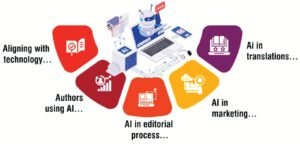
Aligning with technology…
The publishing industry has always thrived on change. From Gutenberg’s press in the fifteenth century to the rise of e-books at the turn of the millennium, each innovation has reshaped how stories travel from author to reader. Today, we stand at another pivotal moment – the age of Artificial Intelligence. Unlike earlier revolutions, this one is not solely about speed or distribution; it is about intelligence itself entering our workflows, offering both tremendous promise and serious responsibility.
Let us begin with the scale of this change. According to PwC’s analysis, the global book publishing industry is expected to reach nearly $150 billion by 2030, with AI driving much of the efficiency and personalisation on which this growth will be founded. And McKinsey projects that AI’s potential could add up to $4.4 trillion annually to the global economy, some of which is certain to trickle down into innovative businesses like ours.
Authors using AI…
In practice, this evolution is already underway. Writers are increasingly incorporating AI-powered writing assistants, such as ChatGPT, Jasper, and Sudowrite, to generate ideas, edit stories, and experiment with style. This doesn’t eliminate the author’s distinct voice – it augments it, allowing writers to focus on creativity while outsourcing mundane or technical tasks. A study by The Bookseller found that nearly 30% of UK authors have used AI tools in the past year to support their writing process.
AI in editorial process…
The editorial is also transformed similarly. Programs such as Grammarly, ProWritingAid, and Hemingway Editor enable faster, more polished editing cycles. Certain publishers are also piloting AI-based plagiarism screening and sensitivity readers to ensure that manuscripts are both unique and culturally sensitive. This has reduced average editorial time by nearly 20%, according to Deloitte’s report, allowing faster release schedules.
AI in marketing…
 Distribution and marketing are perhaps the most obviously impacted. AI algorithms like Amazon’s and Goodreads’ are already making decisions about what we read. Personalised recommendation engines are standard, with Statista research indicating that over 56% of online book sales in 2024 were influenced by AI-based recommendations. Publishers are using platforms such as BookBub, Meta’s Advantage+ AI ads, and StoryChief to segment audiences, monitor behaviour, and run highly targeted campaigns that were previously impossible just a decade ago.
Ai in translations…
The worldwide reach of publishing is also being extended through AI translation technologies. Programs such as DeepL, Google Translate, and Papercup enable rapid, accurate translations of manuscripts into numerous languages. UNESCO estimates that just 5–7% of published material is ever translated internationally, but AI has the capacity to expand this exponentially, projecting an author’s voice far beyond their linguistic limitations.
New formats…
Let us also not forget accessibility, AI’s most valuable contribution. The audiobook sector, which the Audio Publishers Association estimated was nearing $2 billion in 2023, is expanding at double-digit growth rates. Voice AI platforms such as Speechify, ElevenLabs, and Amazon Polly are making audiobook creation faster, cheaper, and more inclusive, particularly for visually impaired readers and in markets where audio is becoming the primary mode of consumption.
Beyond content, publication processes are also automated using AI. Metadata optimisation, royalty tracking, and rights management are also becoming automated. For instance, KNK Publishing Software and Firebrand Technologies are utilising AI to enhance metadata, making books more discoverable amidst digital competition. This makes business operations more efficient while also reducing human error in time-consuming financial and legal processes.
Challenges with AI…
However, these new opportunities bring challenges in meeting them. One area is intellectual property. The Authors Guild in the United States has raised serious questions about what copyright would entail in an AI future and about the value of clear rules to protect human creators. Just as highbrow critics maintain all the machine’s word-crafting powers amount to nothing next to a deficiency in lived experience, or genuine empathy, or the imperishable human something that makes writing last over time.
AI is a supplement…
So, what do all of these leave us with? It leaves us with a responsibility –to use AI as a supplement to human imagination, but never a substitute. To keep our writers empowered, never marginalised; to make publishing quicker, more diverse, and more international, but never forget the human touch that defines storytelling.
Distinguished personalities, history has shown us time and again that every significant step forward in publishing technology—from the printing press to digital—has been accompanied by equal measures of doubt and promise. AI is just the next chapter in the book. The choice before us is not whether it should revolutionise our business—it already has—but how we, as publishers, choose to characterise its impact.
Let us meet this moment with vision, not fear. Let us imagine a future in which ‘tales’ move more quickly, go further, and touch more minds and hearts than ever before – fuelled by AI, but guided ever onward by human imagination and morality.
As much as machines may help us write, edit, translate, and post, it remains human beings who put soul into words.
Sahil Gupta is an entrepreneur & accomplished core Book Publishing Professional with over 15 years’ experience as Director-Founder at V&S Publishers. He is also a Functional Domain Consultant in the Educational and Publishing Space. A B. Tech & MBA, he possesses demonstrated experience in content management, book publishing, ebooks, digital marketing, and business development.