
From Print To Digital: Balancing Technology With Storytelling
In a world increasingly shaped by algorithms and screens, children’s publishing is choosing to introspect and respond with care. As artificial intelligence, augmented reality and immersive technologies steadily enter publishing conversations, children’s books occupy a particularly sensitive space. These are not just products, but formative experiences, shaping imagination, empathy and a lifelong relationship with reading. Smita Dwivedi explores how AR, VR and AI are being approached across children’s publishing today.
Drawing on conversations with Neeraj Jain – Managing Director, Scholastic India; Himanshu Giri – CEO, Pratham Books; Vinatha Viswanathan & Shailaja Srinivasan – Eklavya Team; Natasha Shah Bammi – Publishing Director, Woodpecker Books, and Author Priyanka Agarwal Mehta, Founder & CEO of Sam & Mi who are deeply invested in literature, education and equity, here are excerpts.
A story-first view on technology in children’s publishing
 Neeraj Jain, Managing Director at Scholastic India, brings a measured and deeply considered perspective to the conversation on technology in children’s publishing. At the heart of Scholastic’s approach lies a clear conviction: Story must always come first.
While Scholastic has experimented selectively with interactive and digital enhancements over the years, Neeraj is clear that the company does not use AI in the creation, development, or editorial shaping of its children’s books. For him, children’s literature must remain anchored in “Human Imagination, Authorial Voice, and Creative Intent.” As per him, these elements cannot be automated without losing their emotional depth.
He acknowledges that technology, when used thoughtfully, can play a supportive role. Light interactive elements may help spark curiosity, particularly among reluctant or dormant readers. However, he cautions against allowing digital features to become intrusive, as they risk diluting the emotional connection and imaginative engagement that are central to children’s reading experiences.
 He also highlights practical concerns that publishers must constantly navigate, screen time, age appropriateness, accessibility, and the need to maintain a clear boundary between creative expression and automation. These considerations, he believes, are especially critical when publishing for young readers.
To conclude he reinforces a simple yet powerful truth: “It is strong storytelling that holds a child’s attention”, regardless of format. Technology can support this journey and may help develop hybrid formats that broaden reach, but it can never replace the pull of a well-told story.
Technology to expand reading and build bridges to stories
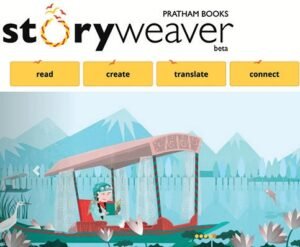
 For Himanshu Giri, CEO of Pratham Books, technology’s true value in children’s publishing lies not in spectacle, but in Access, Reach, and Discovery. Rather than layering digital effects onto books, Pratham Books has focused on using technology as infrastructure; most notably through ‘StoryWeaver’, its open digital platform that hosts, distributes, and enables the remixing of children’s stories across languages and geographies.
While AR and VR have not yet been integrated into Pratham’s publishing programme, the organisation is cautiously exploring how AI can support content discovery, reader segmentation, language recommendations, and the understanding of reading preferences at scale. This exploration remains purpose-led, with a clear emphasis on strengthening the reading experience rather than distracting from it.
 Himanshu identifies several challenges that accompany the introduction of technology in children’s publishing. Chief among them is ensuring that digital tools do not overshadow the fundamental goals of storytelling, which are deep engagement with language, imagination, and narrative. Access remains a critical concern, particularly as many of Pratham’s readers come from low-resource settings with uneven access to devices, connectivity, and digital fluency. Moreover, key aspects of children’s publishing, such as high-quality translation, cultural adaptation, illustration nuance, and age-appropriate storytelling continue to depend on human judgment and creativity, areas where AI has clear limitations.
From Pratham Books’ experience, technology can enhance discoverability and help personalise reading journeys by matching children with stories aligned to their language, reading level, and interests. However, sustained engagement still rests on strong stories, relatable characters, and human mediation by teachers, librarians, and caregivers.
At its best, he believes, technology should function as a quiet enabler in the background, supporting access and choice while allowing stories to remain firmly at the centre.
Innovation beyond tools: Eklavya’seducation-first approach
 Vinatha Viswanathan and Shailaja Srinivasan, Team Eklavya share, “Eklavya is a non-profit, non-government organisation that has spent over four decades developing and field-testing innovative educational programmes across India.”
At the core of Eklavya’s philosophy is a learner-centred approach that encourages children to ask questions, develop problem-solving skills, and engage critically with their natural and social environments. Within this broader pedagogical framework, Eklavya’s engagement with emerging technologies such as AR, VR and AI has been exploratory rather than adoption-drive. In 2024, the organisation hosted an ‘Exposure workshop on Augmented Reality’ with Aurélien Jeanny of Maison Tangible. During the session, Jeanny demonstrated the AR application used in ‘Les Voyages Extraordinaires d’Axel’—a scientific children’s literature project by AurélienJeanny, co-published by Amaterra (the print book) and Maison Tangible (the augmented reality application). The project integrates a traditional print book with a digital AR experience, allowing children to see illustrations come alive by scanning pages through an app.
While the demonstration offered valuable insights into the creative possibilities of AR, Eklavya notes that the costs involved are currently prohibitive, making even pilot projects difficult to pursue.
We maintain clear boundaries around the use of AI in its publishing work. Team members do not use AI in the preparation of books. For Chakmak, the organisation’s monthly science magazine, AI translation was used on two occasions during particularly tight deadlines, purely as a time-saving measure. However, subsequent human editing revealed frequent errors and omissions, leading the team to discontinue the practice.
Although some authors may be using AI tools independently, this is not always evident to the publisher. Some illustrators are also likely to use AI, but this is not considered problematic, as all final outputs are carefully vetted and finalised by the design team, led by Kanak and Ishita. Importantly, Eklavya does not ask for or accept completely AI-generated material, reinforcing its commitment to human judgement and editorial responsibility.
On a concluding note, they shared that for their organisation, innovation remains meaningful only when it aligns with pedagogy, equity, and the long-term development of thoughtful, questioning learners.
The quiet strength of print-first publishing
 As per Natasha Shah Bammi, Publishing Director, Woodpecker Books, an imprint of Wilco Books, children’s publishing remains firmly rooted in traditional, print-first formats. The publisher is currently not using AR, VR, or AI in its children’s list, guided by the belief that young readers, particularly in their early years, benefit most from tactile books, strong narratives, and illustrations that spark imagination without digital overlays.
As Woodpecker Books has not integrated these technologies, it has not encountered direct implementation challenges. However, from a wider industry perspective, she points to several ongoing concerns, which include ensuring accessibility for all children, preventing technology from overshadowing the story itself, and keeping production costs affordable for parents and schools.
From the publisher’s experience, children connect most deeply with stories that leave room for imagination and emotional engagement. While digital elements can introduce novelty, traditional books continue to hold enduring value. Parents and educators, Natasha observes, often prefer formats that encourage focus, independent thinking, and a calmer, more immersive reading experience.
Experimenting with technology with caution
 Author Priyanka Agarwal Mehta, Founder & CEO of Sam & Mi shares that her publishing house has been experimenting with technologies such as AR, VR and AI to see whether they can increase the appeal of children’s books and create stronger bonding experiences between children and adults during reading.
At the same time, she notes that integrating such elements comes with a key challenge: the experience should not become centred on the device used to access the technology. The focus, she emphasises, must remain on the book and the purpose of the story.
From their early experiments, Priyanka observes that the results have sometimes been counterproductive. Instead of engaging more deeply with the story, children often become more interested in exploring the features of the device itself. A similar pattern is visible in toys that incorporate AR or VR.
For this reason, she believes innovation must continue carefully, ensuring that technology supports storytelling without disrupting the reading experience or the bond created through shared reading.
 On a concluding note…
As these diverse perspectives show, technology in children’s publishing is being approached with curiosity as well as caution. While AR, VR and AI offer new possibilities, publishers agree that their real value lies in supporting, not overshadowing stories. Ultimately, it is imagination, human creativity and meaningful reading experiences that continue to anchor children’s literature.