
Tracing Words Across Civilisations
The Making Of A Comparative Tamil–Indo-European Etymological Dictionary
Dr. G. Arasentiran—renowned Tamil etymologist and Chief Editor of the ambitious multi-volume A Comparative Etymological Dictionary of Tamil and Indo-European Languages, reflects on the significance of etymology in understanding cultural memory, the research behind tracing links between Tamil and Indo-European languages, and the scholarly journey of compiling a dictionary that seeks to bridge linguistic histories across continents.
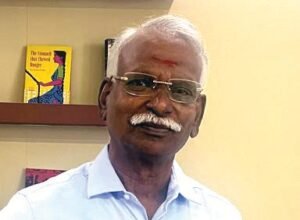 Dr. G. Arasentiran is Chief Editor of A Comparative Etymological Dictionary of Tamil and Indo-European Languages. Launched in March, 2022, this project is duly supervised by the Tamil Development and Information Department, under the aegis of the Tamil Nadu Textbook and Educational Services Corporation. The volumes of this dictionary project are being published by the Oxford University Press in collaboration with Tamil Nadu Textbook and Educational Services Corporation. 12 volumes along with the General Introduction are planned to be released, of which, General Introduction and Volume 1 were released last year. The other volumes are in the pipeline.
Here, he shares more about the project.
 AABP: How would you define etymology, and why does it matter in understanding civilisation and cultural memory?
Dr. G. Arasentiran: Human society being a knowledge society chiefly receives all knowledge through language. And words in language have two meanings viz., dictionary meaning and etymological meaning, of which people mostly are aware of the former. Learning becomes complete only when dictionary meaning is understood along with etymological meaning.
Thus, to know the semantic root (etymological meaning) is to know the history of the root. That is, how the root has undergone an evolutionary development in different contexts, producing many words that retain the same meaning. This etymological study of relating a word to a group of words where it belongs is very fundamental to decipher the usage of a word in any context and decode deeply the message it actually carries or an author truly intends. Or, it can even shed light on ideas and memories not recorded but passed across through generation. Thus, the etymological study has the potential to penetrate the past.
In my viewpoint, the sites preserving the cultural memory are many; however, language is a spacious medium accommodating an explicit account of the memory when others are much narrowed, despite some containing concrete evidence, like monuments. In case of the language, the field etymology, on its path of defining words historically, sheds the original meaning behind the blurry memory of the culture more concretely than has been imagined with randomness. Similar is the case of civilization, which is more multi-dimensional and multi-faceted.
I would like to give an example: wisdom meaning the ‘pinnacle of knowledge’, has emerged from the Tamil vi?i for ‘eye’ as follows:vi?i>vi?i> *weid-‘to see’>wisdom. Here, etymological study has helped as certain the real history of the West Indo-European word wisdom through Tamil. Hence, etymological research remains indispensable.
AABP: What led you to explore connections between Tamil and Indo-European languages?
 Dr. G. Arasentiran: My interest in exploring the relationship between Tamil and the Indo-European languages arose from observing numerous phonetic and semantic similarities between them. I was particularly struck by instances in which Tamil words closely resembled cognates in Indo-European languages and those Tamil words are themselves derived from well-established and conceptually grounded proto-Tamil roots.
These recurring parallels prompted me to investigate the possibility of deeper historical and linguistic connections. In doing so, I found myself engaging with lines of inquiry previously advanced by distinguished scholars such as Robert Caldwell and Stephan Hillyer Levitt, whose work has significantly contributed to comparative linguistic studies in this area.
AABP: What inspired you to undertake A Comparative Etymological Dictionary of Tamil and Indo-European Languages?
 Dr. G. Arasentiran: There are two things that inspired me to take this endeavour: More than 300 hypothetical roots out of 461 identified by English etymologist Skeat have similarities with Tamil source words and can be traced back to Tamil parent roots.
The second thing that inspired me is the Dravidian Ascent Theory postulated by distinguished etymologist like Pavanar and Gnanaprakasar which foregrounds that Tamil belonging to the Dravidian family of languages was the language spoken all over the Indian sub-continent about 4000 years ago and there are enough research findings and data to show that in its north-western journey it had evolved into Indo-European.
AABP: How long did the research take, and what were the most demanding aspects of compiling such a dictionary?
 Dr. G. Arasentiran: I have been deeply involved in this domain of etymology since my graduation in Tamil in 1972 and the Tamil and Indo-European Dictionary research work presently engaged has started from March 2022.
Finding out the etymological connection between Indo-European cognates and their hypothetical roots and their corresponding Tamil source words is the most demanding part of our work.The second part is tracing the lexical development of derivatives of the East and the West to their corresponding Tamil source words.
Besides, making of a dictionary of this scale is nevertheless a Herculean task, and our team is up for it.
AABP: Who is the primary audience for this book—linguists, historians, serious scholars, or informed general readers?
Dr. G. Arasentiran: This dictionary project explains in detail the history of the evolution of langue in human society how language is indispensable and of great assistance to mankind. Thus, more than being a linguistic study, it goes on explaining the history of art, literature, culture, philosophy, science, and technology through the thousands of words, the history of which has been detailed in this dictionary. Therefore, readers across diverse fields interested in unravelling the historical depth and evolution of the words could be the primary audience.
AABP: Were there any discoveries during your research that you found particularly striking?
Dr. G. Arasentiran: We can cite the history of hundreds of words in substantiation. Take for example the word science which means studying the physical world and the materials by separating and segregating each from the other. According to English etymological dictionaries, the word science had risen from the hypothetical root *skei- meaning ‘to cut, to split’. But the fact remains that it had evolved from the Tamil root word ceku ‘separate/parting’. The word ceku has been widely employed in Ca?kam literary poetic compositions and in Tirukku?a? couplets to denote ‘to separate’.
The Tamil word vekku, meaning ‘heat’, under va>pa sound change has mutated into bhaksha?a (vekku>bekku>bhaksha?a) in the East Indo-European and Proto-Germanic *bakan ‘to bake’ (vekku>bekku> *bakan>bake) in the West Indo-European. Without realising this, the West Indo-European etymological dictionaries have identified *pekw-, a hypothetical root assigning the meaning ‘to cook, ripen’. English etymological dictionaries have related a host of words like bake, cook, kitchen, cuisine, (terra)-cotta and (bis)-cuit as being related to and derived from this *pekw-.
AABP: How receptive was the publishing ecosystem to a specialised linguistic reference work of this scale?
Dr. G. Arasentiran: Publishing houses in general are mostly commercial entities. The dictionary series in the Comparative Etymological Dictionary of Tamil and Indo-European Languages is a product of highly nuanced and in-depth intellectual engagement, greatly contributing to enhancing understanding of the academic domain. It is indeed a struggle to make the world understand this fact. Only after two years, we signed anagreement with the Oxford University Press, that we consider the turning point in our journey, as OUP readily accepted our hypothesis.
AABP: How can comparative etymology foster dialogue rather than division?
Dr. G. Arasentiran: Comparative etymology mainly studies words and cognates between languages. The Dictionary project postulates that these similarities suggest a shared common origin between the languages, thereby helping foster unity among peoples of different races.
AABP: What role do you see digital tools and AI playing in the future of etymological research?
Dr. G. Arasentiran: More than books, knowledge acquisition in today’s world happens through digital media. When it comes to the etymological research, what we need is multilingual data. Though internet helps us with the data, advanced AI systems trained on comprehensive lexical and philological datasets can help synthesize information. But, evaluating the data and inferences of AI is essential, which reiterates the fact that the expertise of humans in verifying the authenticity of the data is indispensable. However, the comprehensive inputs of AI could certainly benefit anyone looking for cross-linguistic traces. In this way, AI has the potential to accelerate research and promote the depth of etymological study.
For instance, if the Dictionary series is fed into AI, anyone across the world searching for the origin of a word, may see its traces in Tamil roots, which he/she would have never thought of. In such a context, the world will witness the depth and extent of etymological research.
AABP: What would you like readers to ultimately take away from your book?
Dr. G. Arasentiran: The basic needs of mankind are food, clothing, and shelter. Most of them are being met through educational, scientific, and technological advancement. Apart from these mundane things, it is necessary for human society to blossom. This dictionary series reveal to the world the deeper truths about language. As such, this project will serve the purpose of enriching every individual with deep and clear insights on the origin and development of the words,ensuring holistic development in domains such as education, science, technology, and philosophy.
Dr. G. Arasentiran (a) Rajendran is a renowned Tamil etymologist and a Nostratic Scholar. A retired professor and HOD of Tamil department at the reputed Madras Christian College,Chennai, Dr. G. Arasentiran is currently the Chief Editor for the project titled ‘A Comparative Etymological Dictionary of Tamil and Indo-European Languages’.
For the past 40 years, he has studied Tamil-Indo-European etymological relationships analysing the works of Caldwell, P?v??ar, ???appirak?car, and the East and the West Indo-European etymological dictionaries. He was honoured with the T?van?yap P?v??ar award bythe Tamil Nadu Government in 2021. He has written and published books such as Ulakam Paraviya Tami?i? V?r-Kal (TheWorldwide Spread of the Tamil Root: Kal), Tami?umInt?-Air?ppiya Mo?ika?um: Mo?i U?avu ?yvu (Tamil and Indo- European Languages: Study of Language Relations), and Tami?kkappal (The Tamil Ship).