
The Senior Writer Who Recognised His Reader As A Contemporary Scholar
Dr. Sankara Saravanan pays tibute to Kaviperarasu Vairamuthu, Vignette of Vaikarai Vasakan.
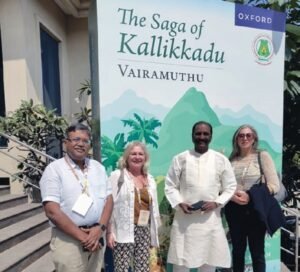 I first encountered Vairamuthu, the recipient of the Jnanpith Award in 2025, during my college days in 1996. When I look back across these thirty years, I realize something interesting: his writings slowly transformed me from a casual reader into someone who could discuss literature with him as a contemporary scholar. The most remarkable part is that he himself once acknowledged this transformation. Not many celebrated writers publicly elevate their readers to such dignity. That gesture alone reveals the generosity with which he views the relationship between writer and reader.
There are writers who frequently proclaim that whatever they produce is Ilakkiyam (true literature) while the works of others are merely Legiyam—that bitter herbal paste we swallow only for medicinal purposes! Kaviperarasu is not from that school of literary arrogance. He belongs to the rarer species of writers who quietly cultivate readers instead of competing with them.
In the literary world, there are writers who silence readers and writers who awaken them. Vairamuthu clearly belongs to the second category.
A phone call that turned into a meeting
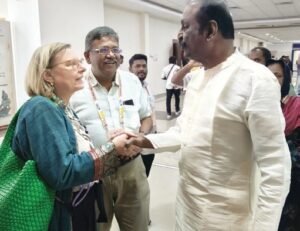 My first meeting with him happened on 15 October 1996. At that time I was studying at the Veterinary College in Namakkal. During a visit to my hometown Madurai, I noticed posters announcing that Vairamuthu was staying at Hotel Supreme for a literary function.
Encouraged by the fact that I had won a prize in the oratorical contest at the Eighth World Tamil Conference, I decided to try my luck.At the reception I was told politely that meeting him that day was impossible. I could come the next day.But that was inconvenient. I had to return to college.
So I used what may be called a minor literary exaggeration.“I came all the way from Namakkal only to meet him,” I declared with dramatic sincerity.(The truth, of course, was that I had come home for my weekend holiday and discovered his presence only from posters!)
The receptionist relayed my message. Soon the phone was handed over to me. From the other end came that unmistakable voice:“Saravanan Vanakkam… Naan Vairamuthupesaren. Vazhthukkal. We will meet next time. I am getting ready for a function.”
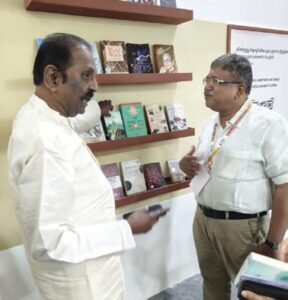 Most fans would have ended the conversation there with gratitude. But youthful courage—or perhaps youthful foolishness—sometimes produces interesting outcomes. I replied:“Sir, in your autobiography you wrote that when you went to meet Kannadasan as an admirer, you couldn’t get proper time with him and it hurt you. Later he wrote the foreword to your first book. But that earlier disappointment stayed in your mind. Now you are repeating the same story with me. Why can’t you give me just five minutes?”
There was a brief silence.Then he said calmly:“Please come to my room. Third floor.”Argument accepted!
He spent nearly twenty minutes with me. More importantly, he patiently signed seven books I had brought to distribute as prizes in my college competitions. Instead of simply signing his name, he asked for each winner’s name and wrote personalized greetings.At that moment I understood something about literary greatness:real poets sign books; great poets sign encouragement.
The second encounter – eleven years later
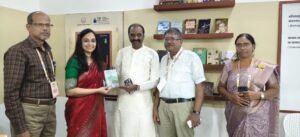 Years passed. In 2007, my first book Kaiyalavu Kalanjiyam was published by Vikatan. Like most first-time authors, I enthusiastically bought one hundred copies and distributed them to friends, relatives and well-known “intellectuals”.The response was educational. Competitive exam aspirants who bought the book from the market appreciated it warmly.But many who received the free copy maintained a majestic silence—as if appreciation required clearance from Department of Price and Appreciation, Govt of India headed by an Additional Chief Secretary.
Fortunately, earlier encouragement had come from the celebrated writer Sujatha Rangarajan, who had seen a portion of my compilation when it appeared as a supplement in Chutti Vikatan and advised me to publish it as a book.Still, without expecting any praise, I decided to present a copy to Vairamuthu.
One morning I visited his house in Trustpuram. I handed over the book.“Have you written this? Vikatan publication? Good… I will look into it.”That was all. He moved on. I returned home satisfied simply because I had seen him again after eleven years.
The unexpected call
The next day—Christmas Day—I received a phone call. It was Vairamuthu.He had already read the book. More surprising was the attention he had given to its details. He appreciated: the 30 one-line notes on women poets of the Sangam age,the 63 concise notes on the Nayanmars,the clear differentiation between virus and bacteria,and several other features.
Finally he quoted a line from the second poem of Kurunthogai and said my work resembled “Konguther Vaazhkkai Anjirai Thumbi”—a rare beetle that collects pollen only from select fragrant flowers.“In the same way,” he said, “you have collected information selectively and compiled this book.”For a young author who had just experienced the silence of his own acquaintances, that sentence felt like a literary doctorate.
A few words about the poet
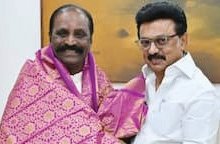 Vairamuthu is not only a poet but also a prolific lyricist who has shaped Tamil film music for decades. He has won seven National Film Awards for Best Lyricist, the highest number for any Indian lyricist. He has also received the Sahitya Akademi Award for his literary work and has authored several celebrated books including Kallikattu Ithikasam. Like the Chilean Nobel laureate Pablo Neruda, who wrote “Poetry arrived in search of me,” Vairamuthu often appears as if poetry itself chose him as its messenger in Tamil. And one may also recall the wisdom of Gabriel Garcia Marquez, who said that the duty of a writer is not merely to tell stories but to make readers feel that life itself is larger than they imagined. In my case, that enlargement happened through a few encouraging words over the telephone.
Why the title fits?
That is why I describe him as “the senior writer who raised his reader as a contemporary scholar.”He did it through three simple qualities: Respect for readers; Encouragement for emerging writers; and Attention to intellectual detail.
Dr. T. Sankara Saravanan is a distinguished Tamil Scholar and Principal (Competitive Exams) of Govt of Tamil Nadu. He is an expert in All India Civil Services Training and Honourary Advisor to Tamil Nadu Textbook and Educational Services Corporation and Co-ordinating Officer of Rights Committee of Chennai International Book Fair 2026.
Comments are closed.