
Bhashavaad 3.0: Translating India in the Age of AI
Two days of conversations at Ashoka University examined how translation, technology and multilingualism are reshaping India’s literary and publishing ecosystem. A report by Smita Dwivedi.
Smita Dwivedi
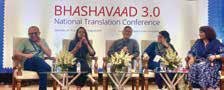 The third edition of Bhashavaad: National Translation Conference, organised by the Ashoka Centre for Translation (ACT), part of the Harish and Bina Shah School of Humanities at Ashoka University, in partnership with The New India Foundation, brought together writers, translators, publishers, scholars and practitioners. Across two days, the conference examined translation, Indian languages, literary traditions, reading cultures and the changing relationship between artificial intelligence and creative work.
Translation as an Expression of India’s Multilingualism
Opening the conversation, ACT Co-Directors Rita Kothari and Arunava Sinha reflected on the Centre’s larger vision. ACT seeks to work across Indian languages, including translations from one Indian language into another and into English, covering literary and popular writing as well as political, scientific, oral and written material.
For Kothari, translation is not merely a response to multiple languages but an expression of India’s multilingual reality. She described it as a space where ideas, cultures and texts have travelled across time. Sinha spoke about the richness that becomes visible when Indian literatures are brought into conversation, allowing readers to encounter traditions beyond their own linguistic boundaries.
AI Enters the Translation Debate
One of the strongest threads running through the conference was the growing presence of artificial intelligence in translation and publishing.
The presentation of the ACT-IDAF Fellowship for Research into AI Translation from Malayalam examined what AI can and cannot currently do in literary translation. The research indicated that AI can respond effectively when provided with targeted, context-specific human guidance, but its output continues to require considerable human intervention and editorial judgement.
The difficulty becomes particularly visible when translation involves cultural references, emotional registers, psychological textures and contextual meanings that cannot always be transferred accurately through automated systems.
The discussion also raised questions of ethics, copyright, authorship and responsibility, underlining the continuing importance of human interpretation when cultural context is involved.
Writing and Publishing in the Age of AI
In ‘Writing and Publishing in the Age of AI’, Karthika VK, Chiki Sarkar, Arunava Sinha and Debayan Gupta, in conversation with Rahul Matthan, examined how AI is affecting different stages of publishing.
The discussion touched upon manuscript editing and reviewing, idea generation and illustration, alongside questions about creativity, originality and the economics of publishing. Chiki Sarkar, Founder, Juggernaut Books, challenged the assumption that AI and creativity must necessarily be in conflict. She pointed to its growing use within publishing and argued that its usefulness depends on human imagination and judgement.
Who Gets to Define Modern India?
In ‘Being Indian, Being Modern’, moderated by publisher, writer and feminist Urvashi Butalia, J Devika, Banani Chakravarty, Anita Bharti and Rakhshanda Jalil examined Indian identity and modernity through language, literature and lived experience. The discussion considered how ideas of modernity differ across communities and regions, and how marginalised voices can be excluded when dominant narratives define the conversation.
Bringing Adivasi Literary Traditions into the Conversation
The question of representation continued in ‘An Unanswered People’, drawing from an anthology of contemporary Adivasi poetry, the session explored the diversity of Adivasi languages and literary traditions. It also questioned the tendency to approach Adivasi writing primarily through the framework of marginalisation.
Translation emerged not simply as a means of reaching wider readerships, but also as part of a larger discussion about preserving languages and scripts and increasing the visibility of literary traditions that have historically received less space in mainstream discourse.
When Writers Meet Their Translators
The relationship between writer and translator came into focus in ‘The Writer and Her Translator’. The session looked at translation as a collaborative process involving trust, interpretation and negotiation. It highlighted how carrying a literary work across languages involves choices beyond vocabulary and syntax, particularly when recreating tone, cultural references and the author’s larger intent for another readership.
What Is India Reading?
In ‘What Is India Reading?’, B Srinivasan, Semanti Ghosh and Jayant Mammen Mathew, in conversation with Manish Sabharwal, Co-founder of TeamLease Services and Ashoka University, examined India’s changing reading landscape and evolving literary consumption.
Translation Beyond the English–Indian Language Binary
A significant aspect of ACT’s vision is its attempt to move beyond the familiar model in which an Indian-language text is translated primarily into English.
The Centre’s stated ambition is to facilitate translation across India’s many languages, including translations from one Indian language into another. This expands translation from a one-way movement towards English into a more interconnected multilingual exchange.
The Centre also showcased initiatives such as Women Translating Women and Chronicles, alongside upcoming collaborations aimed at taking Indian literature and ideas to wider audiences.
The Larger Conversation
Across its two days, Bhashavaad 3.0 brought together conversations on the future of Indian multilingualism and the growing role of AI in creative and publishing industries.