
Myth, Mystery, And A Milestone: Ashwin Sanghi On Winning The Inaugural Jsw Prize
Bestselling Indian author Ashwin Sanghi has made history by becoming the first-ever recipient of the JSW Prize in Literature. In this interview with Varsha Verma, the master storyteller reflects on the profound weight of this inaugural recognition, the evolution of the Indian publishing landscape, his thoughts on the rise of AI, and what lies ahead for his millions of readers worldwide.
 Ashwin Sanghi has been named the first-ever recipient of the JSW Prize in Literature, instituted by the Drukyul’s Literature and Arts Festival of Bhutan. He will be honoured at the festival’s 15th edition, held under this year’s theme, “The Art of Being Human. “The JSW Prizes were conceived in 2025 to commemorate the 70th birth anniversary of Bhutan’s fourth king, Jigme Singye Wangchuck. The initiative aims to celebrate the power of creativity, culture, and ideas in enriching the shared human experience. Here, Ashwin Sanghi shares more the award and more. Excerpts.
AABP: Congratulations on becoming the inaugural recipient of the JSW Prize in Literature. What was your first reaction when you received the news, and what does this recognition mean to you personally and professionally?
Ashwin: My reaction is of quiet gratitude. To be the first recipient of any honour carries a particular weight — you are not joining a list, you are helping to begin one. That is humbling. Personally, it means a great deal that this recognition comes from Bhutan, a country I have long loved and whose relationship with Bhutan Echoes has been among the most enriching threads of my literary life. To receive it under the Royal Patronage of Her Majesty the Queen Mother—herself an accomplished author—makes it especially meaningful. Professionally, it is an affirmation of a belief I’ve held from my very first book: that popular fiction need not be intellectually shallow, and that a story can carry the weight of history, legend, philosophy, spirituality and science while still being a page-turner.
AABP: The award recognises your ability to blend history, mythology and contemporary storytelling. What do you think makes this combination resonate so strongly with readers across generations?
Ashwin: Myth is simply memory that has learned to travel across centuries. When I connect an ancient thread to a contemporary chase, I’m not decorating fiction with history—I’m showing readers that they are standing on a continuum. The questions our ancestors asked about power, faith, mortality and meaning are the same ones we are asking today, only in different costumes. Younger readers come for the thriller and stay for the history. Older readers come for the history and are delighted to find a thriller.
AABP: Looking back at your journey from The Rozabal Line to your latest works, how has your approach to storytelling evolved over the years?
Ashwin: The Rozabal Line was written by a man in love with the idea of a conspiracy—dense, sprawling, hungry to include everything I had discovered. Over the years I’ve learned that restraint is its own craft. The research still runs deep, but I’ve become far more ruthless about what actually earns a place on the page. The reader should feel the depth of the iceberg without being made to inspect all of it. I’ve also grown more comfortable moving between registers — from the civilisational sweep of the Bharat books to the leaner, sharper pulse of crime fiction. Early on I thought a writer had to pick a lane. Now I believe the lane is simply your voice, and one can modulate it to suit different situations.
AABP: Your novels are known for meticulous research. How do you strike a balance between historical accuracy and imaginative fiction?
Ashwin: I follow a simple principle: be faithful to the spirit of history and fearless with the gaps in it. Where the historical record is firm, I do not bend it. But history is full of silences—undocumented years, unexplained decisions, missing motives—and those silences are where fiction is invited to sit. I do the research first and imagine second, never the reverse. And at the end, I always remind myself that I’m a storyteller, not a historian. My job is not to teach the past—it’s to make the reader feel it, and then, hopefully, go read the real history for themselves.
AABP: Indian commercial fiction has grown tremendously over the past two decades. How do you view the evolution of the Indian publishing industry during this period?
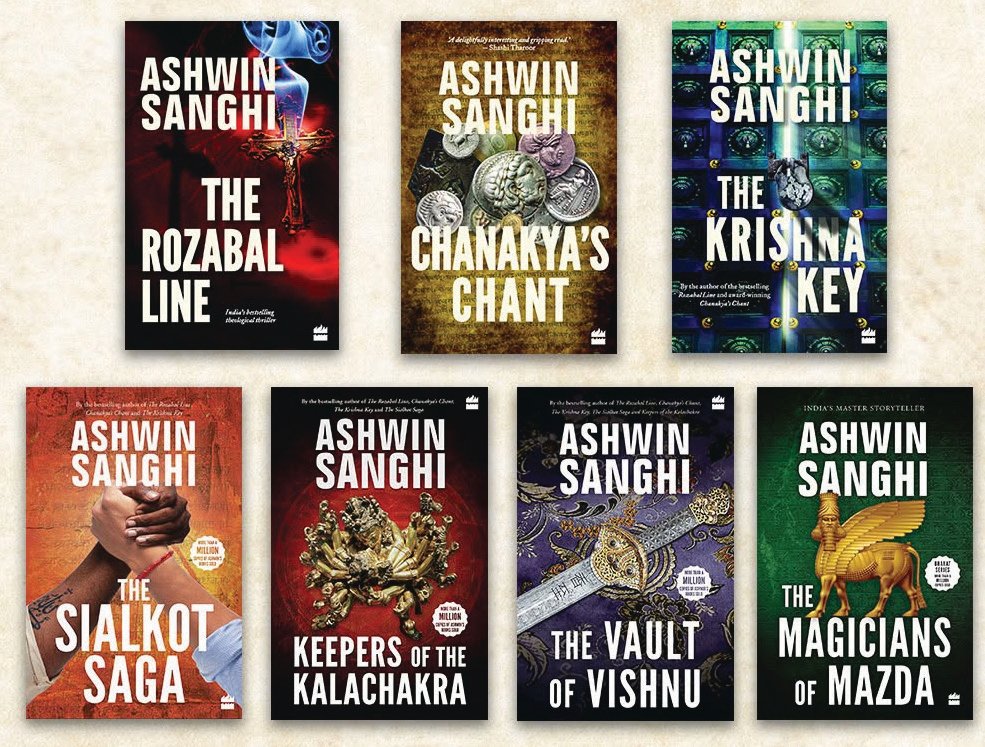 Ashwin: Twenty years ago, Indian writing in English was largely expected to be literary, diasporic and prize-facing. The idea of an unapologetically commercial, home-grown thriller was almost an oxymoron. That has changed completely. We now have a vast, confident readership that wants Indian stories told in Indian idioms—and an industry that has finally learned to serve it. What excites me most is that the readers came from within India, not from validation abroad. Regional-language publishing, translations, and a booming audio market have widened the tent enormously. The challenge now is discoverability—more books are published than ever, and the hardest task for a good book is simply being found.
AABP: Digital books, audiobooks and AI are transforming publishing. Which developments excite you the most, and which ones concern you?
Ashwin: Audiobooks excite me the most. They return us to the oldest form of storytelling—the spoken tale around a fire—and they’ve brought stories to people who don’t have the time or habit to sit with a physical book. In a country with our oral traditions, that feels like a homecoming. AI is more complicated. As a tool for research, for organising vast material, for first edits, it’s genuinely powerful. What concerns me is the flattening of voice. My hope is that AI handles the scaffolding and leaves the soul of the work to the writer.
AABP: How do you overcome periods of self-doubt or writer’s block?
Ashwin: I’ve stopped treating writer’s block as an enemy to be defeated and started treating it as information. Usually it means one of two things: either I haven’t done enough research and my subconscious knows the foundation is thin, or I’m trying to force a scene that the story doesn’t actually want. When I’m stuck, I go back to the material rather than staring harder at the blank page. Reading refills the well. The other discipline is simply showing up. Inspiration is unreliable, but habit is not. I’d rather write a bad page that I can fix tomorrow than wait for a perfect one that never comes. You cannot edit a blank page.
AABP: After this significant recognition, does it inspire you to explore new genres or storytelling formats?
Ashwin: Recognition has a way of granting you permission to take risks, which, to be fair, I’ve done quite a lot of with my Bharat Collection, my crime thrillers and my non-fiction and self-help. But I’m also intrigued by newer formats and how stories can live across mediums rather than only on the page. That said, I’m wary of chasing novelty for its own sake. A new format is only worth pursuing if the story genuinely needs it. The honour makes me bolder, not restless.
AABP: What can readers expect next from you?
Ashwin: Two very different books, which is exactly how I like to work. First, a new crime thriller in my Kutta Kadam series, arriving in 2026 — the genre has become a genuine joy for me, all pace and precision and misdirection. And then, in 2027, the ninth book in the Bharat Collection, which returns me to the larger civilisational canvas of history, mythology and ideas that readers of that series know well. I like keeping both muscles active; the discipline of crime fiction sharpens the sweep of the epic, and the epic gives the crime its depth.
AABP: Finally, what message would you like to share with aspiring Indian writers who hope to build enduring literary careers while remaining true to their own voice?
Ashwin: Five things, learned the hard way.
First, write — don’t merely think about writing. Every aspiring author carries a masterpiece in their head; the page is where it either lives or dies. Ideas are cheap. Finished manuscripts are rare. Be one of the rare ones.
Second, don’t fear the critic. Criticism isn’t the opposite of success — it’s part of the same game. The moment your work reaches readers, it stops being yours alone, and not everyone will love it. Make peace with that early, and it loses its power to wound you.
Third, and I mean this quite literally — don’t give up the day job too soon. It’s very hard to write on an empty stomach. Financial pressure is the enemy of creative patience. Let a steady income buy you the freedom to write without desperation.
Fourth, treat rejection as part of life rather than a verdict on your worth. I’ve had my share of it. The good news is that the gates have multiplied — self-publishing, digital platforms, audio, regional markets. A “no” from one door no longer means the room is closed.
And finally, if success does come, stay humble and remember its source. I believe our gifts are not entirely our own doing. When the words flow, I thank Ma Saraswati — because I know she made it happen. A little gratitude keeps both your feet and your ego on the ground.
Comments are closed.