
Using Wordless Art to Protect Nature!
Can a story change the way you see the world without using a single word? French illustrator Juliette Armagnac believes it can. During her art residency in Bhopal, India, she created a unique picture book called Jungle Dhun. By using only illustrations, Juliette hopes to connect people from different cultures, shine a light on the dangers of light pollution, and inspire us to protect our planet’s endangered animals.
Featured Illustrator: Juliette Armagnac, French Illustrator
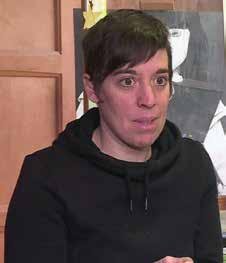 French illustrator Juliette Armagnac was born with a pencil in her hand! During her Villa Swagatam residency at Eklavya Foundation, Bhopal in 2025-26, Juliette created Jungle Dhun, a picturesque journey through the forest. A young protagonist, woken up by a loud call in the middle of a jungle at night, sets out in search of the source of the unfamiliar call discovering the rhythms and wonders of nocturnal life along the way. The Villa Swagatam residencies, supported by the Institute of France in India are designed to foster cultural exchange. Here’s more.
Why Wordless Stories…
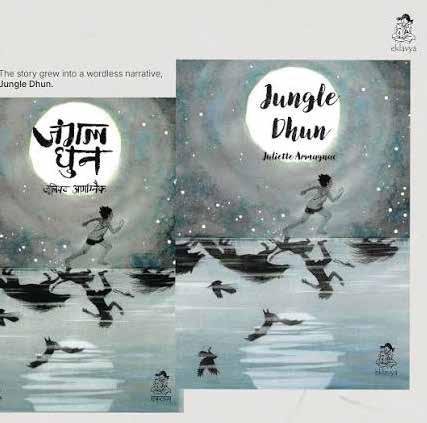 “I’ve always loved wordless stories. They leave so much room for readers and for exchanges between parents and children, who can imagine dialogues, add the sound of the wind, or comment on the images together. They also invite you to simply contemplate the illustrations, turning the pages at your own pace, in silence. It’s a difficult exercise, though, because the images need to contain enough clues for the story to be understood, while creating enough intrigue to make you want to keep reading,” shares Juliette.
“The way we write down sounds and animal calls is specific to each language. It says something about the relationship we build with the world around us and the particularities of our cultures. I wanted to create a kind of universal language that would belong to the same visual world as my illustrations, using the same tools and gestures. I also wanted sounds and landscapes to become one, to be inseparable, as they are in real life.
That was a challenge for me because I naturally tend towards realism. I listened to the different sounds made by the animals in my story and simply let my hand trace the rhythms they inspired,” she adds.
Message Through Jungle Dhun…
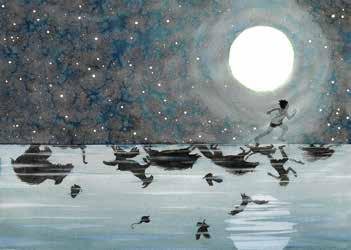 “The world around us is complex and full of interactions we may not even be aware of. I would like to awaken readers’ curiosity and encourage them to open their eyes and ears, to do research, seek out information, and learn to recognise the plants and animals with whom we share this planet and its resources. I also want them to understand just how deeply interconnected we all are,” shares Juliette.
“The night is full of mysteries, but once you learn to recognise its sounds and shadows, it becomes less frightening. At the very least, you become able to distinguish between fear caused by a genuine potential threat and fear caused simply by not knowing. By learning about the world around us, we also learn to love it. And that is essential if we want people to feel the desire to protect it,” she adds as a matter of fact.
Opportunities and Challenges for a Wordless Book…
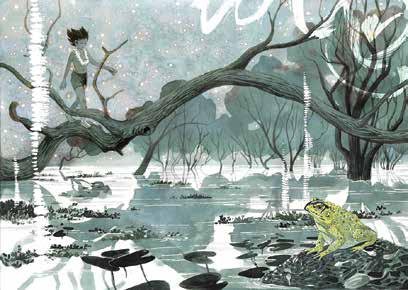 “In France, wordless children’s books are quite rare. Publishers tend to see them as difficult to market because they can sometimes intimidate parents. But their great advantage is that they can be read and understood in any country, and I hope Jungle Dhun will travel across borders!” shares Juliette.
On Her Artistic Journey…
“Everyone in my family has always drawn, even though no one ever made a profession out of it. So I’ve been drawing since childhood, because I was very quickly given a pencil and paper to keep me busy: it doesn’t cost much, and you can take it anywhere! I used to think that if I couldn’t find a job when I grew up, I could always illustrate books… but I had no idea it was an actual profession!” shares Juliette.
“My mother encouraged me from a very young age to study applied arts, and I was fortunate to find several foundations that helped finance my studies over the years. I worked very hard, and at 18 I entered École Estienne in Paris, where I studied illustration and the book arts.
For several years, I illustrated texts by authors that publishers brought to me, before gradually figuring out what I wanted to tell myself. Today, I’m beginning to write my own stories, with or without words, and to explore comics as well,” she adds.
On Residency at the Villa Swagatam Programme…
“The residency far exceeded my expectations. I was incredibly well received and very quickly felt at home, safe and supported. I also felt completely aligned with the values and work of the Eklavya Foundation. I had the feeling that I was exactly where I needed to be, with the right people. What began as a simple idea became a real story with several layers of meaning, rooted in a specific place.
Through Eklavya, I met a great number of people who helped me discover the natural, historical and cultural heritage of Madhya Pradesh. Their languages, interests, passions and knowledge allowed me to develop a more authentic and complex understanding of the region. Many of my interactions involved gestures, facial expressions, sounds or little sketches, which reinforced my belief that a wordless book was possible: we can understand one another without sharing the same language or culture! These working conditions helped me avoid falling into cultural appropriation,” she shares.
“Our cultures, ways of life and everyday environments are so different. And yet, we also share common concerns, particularly when it comes to fighting discrimination in all its forms and protecting ecosystems from destruction. It reinforced my belief that joining forces is always a more effective way to make things move forward,” she adds.
On Working in India…
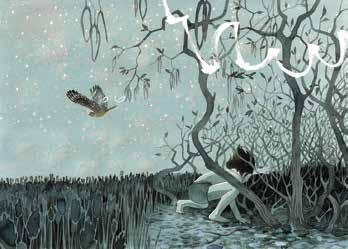 “I had already been to India as a child, when my mother was on a purely spiritual journey. I was happy to rediscover the smells, flavours and ways of life that are so different from those in Europe, particularly the omnipresence of plants and animals even in urban spaces. But to be honest, French people often have a very romanticised image of India…. one of the great advantages of a creative residency is that you are constantly interacting with people from all kinds of backgrounds. They don’t treat you as a tourist, but as someone they are working with, and that completely changes the experience,” tells Juliette.
She adds, “I realised how much our expectations and Western preconceptions can blind us and cause us to miss so many opportunities for discovery and learning. I became very aware of the extent of my own ignorance. India’s heritage, both tangible and intangible, is extraordinarily rich. I think we in France could approach other cultures with a little more humility and curiosity!”
Message to Aspiring Illustrators…
“A wordless story is not a story without words. I think it’s essential to tell your story before you begin drawing it: say it out loud, tell it to other people, and let it evolve until it makes sense both to you and to others.
In an image, everything carries meaning: the graphic technique, the way things are represented, the choice of colours, the framing… So I would say: take the time to consider every detail and try to create a coherent, meaningful whole in which text is no longer necessary because the images already tell us what matters,” shares Juliette.
What Next?
“I’m going to continue the work I began with Jungle Dhun around communication between species. I’d like to extend that dialogue to plants and fungi, which also interact, with one another and with animals, through other forms of language that I would like to try to represent visually.
We also have other projects in the works with Eklavya… but this is a surprise!” concludes Juliette.